|


|
| Store | Distance | Phone | Buy | |
|---|---|---|---|---|
| Loading... | ||||
''Pisces, Aquarius, Capricorn & Jones Ltd.'' was the fourth album by The Monkees, released on November 6, 1967, when the Monkees were exerting more control over their music and actually playing many of the instruments themselves, something their record company had previously forbidden (on their first two LPs). The group did employ studio musicians to a greater extent than their previous album, ''Headquarters'', on which the four musicians played almost entirely on their own. Guitarist Michael Nesmith is heard vocally on this album more than ever before, singing lead on five cuts; conversely, Micky Dolenz sings lead on only three tracks after dominating the group's first three albums. The album's single, "Pleasant Valley Sunday"/"Words", was a double-sided hit.
The album is particularly interesting for the pioneering use of the Moog synthesizer, which Micky Dolenz introduced to the group and played in the studio; he owned one of the first twenty ever sold. ''Pisces'' is perhaps the first hit rock or pop album to feature the Moog. In any event, ''Pisces'' is one of the first few commercially issued recordings in any musical genre to feature the instrument. Micky Dolenz plays the synthesizer on "Daily Nightly" and "Love is Only Sleeping" while electronic musician Paul Beaver plays the Moog on "Star Collector."
Two additional songs, which eventually became the single "Daydream Believer"/"Goin' Down", were recorded during the album sessions. Released in October 1967 as a prelude to the ''Pisces'' album, it would be the group's last #1 single.
The album's title stems from each band member's respective astrological sign (Dolenz is Pisces, Peter Tork is Aquarius, and both Nesmith and Davy Jones are Capricorn). However, since Nesmith and Jones share the same sign (as well as the same birthday, December 30), Davy's last name was placed at the end of the title to avoid confusion. ''Pisces, Aquarius, Capricorn & Jones Ltd.'' sold over 2 million copies as Colgems #104.
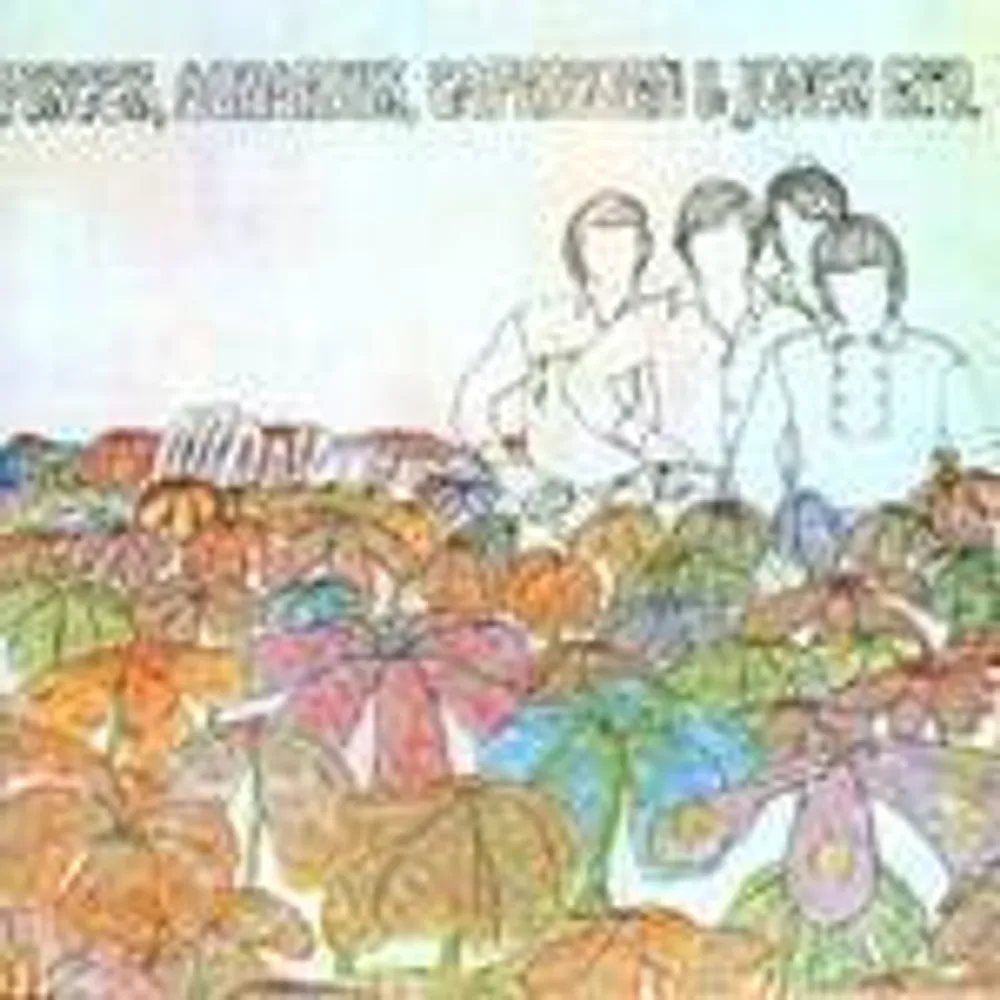
The album's cover features a drawing by Bernard Yezsin of the four Monkees, their facial features blank, standing in a field of flowers with the group's guitar logo half-buried. The drawing was based on a photo of the group Yezsin had taken.
In 2007, Rhino issued a two-disc deluxe edition of the album. The CD set is housed in a digipak with a slipcase and features original album artwork (including replicas of the original Colgems vinyl labels on each disc), as well as a booklet of essays and session information by Monkees historian Andrew Sandoval. The discs contain both the stereo and mono mixes of the album, remastered, as well as alternate mixes and outtakes. - Wikipedia
Proudly supported by our partners